Amsterdam and The Hague, 1632–1677
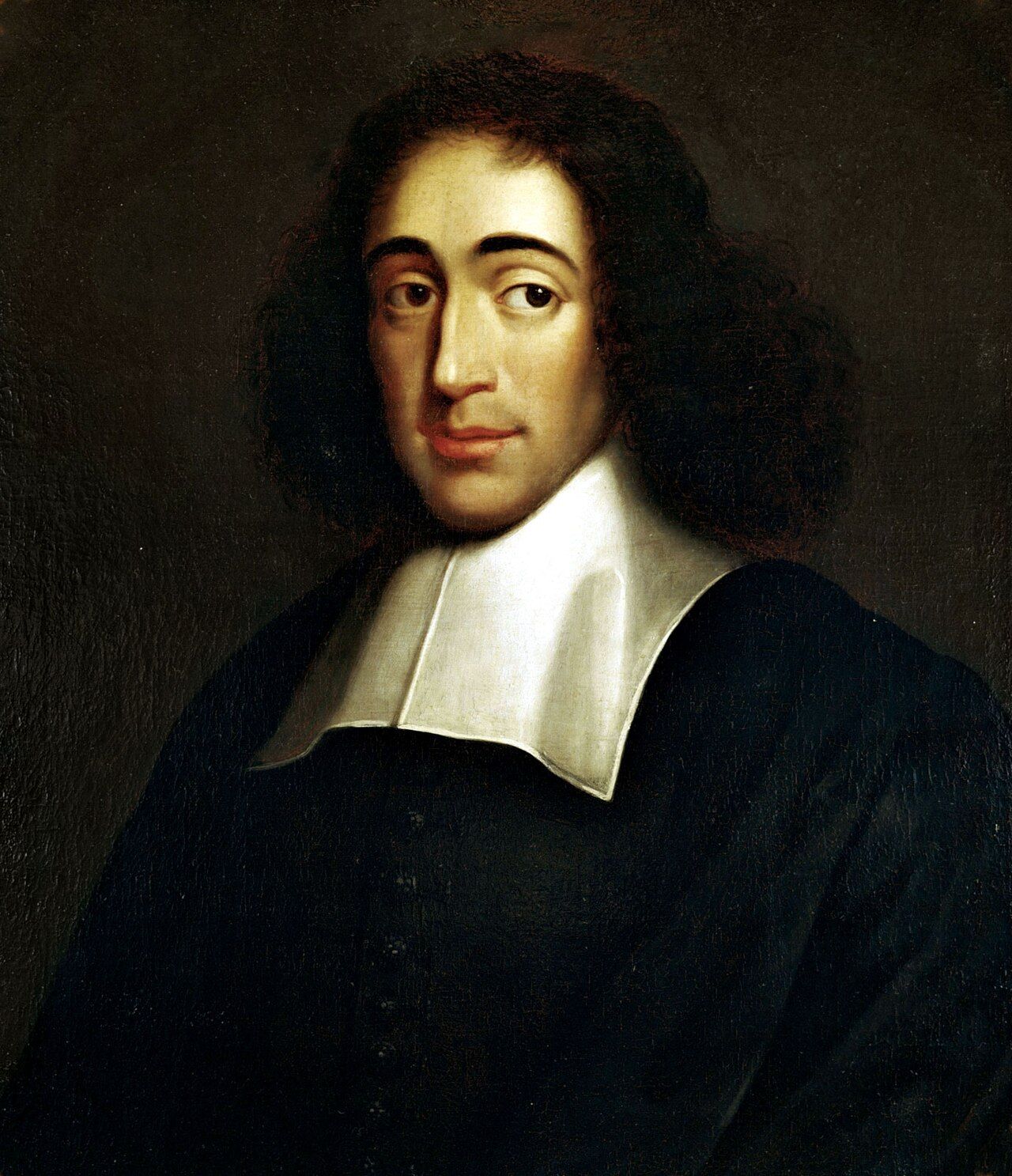
Baruch Spinoza
People think they are free because they are aware of their actions and ignorant of the causes that determine them. There is no free will. But there is freedom, and it grows as we understand the causes that move us.
The view
Spinoza's Ethics, published just after his death in 1677, sets out a complete system in the manner of Euclid, with definitions, axioms and proofs. There is only one substance, which he calls God or Nature. Everything that exists is a mode of it, and everything that happens follows from its nature with the same necessity with which the properties of a triangle follow from the triangle's definition. There is no chance, and nothing is contingent. Even God does not act from free will in the ordinary sense; God acts from the necessity of his own nature.
Human beings are no exception. The will, Spinoza argues, is not a faculty separate from the intellect, able to choose either way; it is simply the affirming or denying that goes on in each idea. So there is no free will. Yet the last part of the Ethics is called "Of Human Freedom". Spinoza's freedom is not a gap in necessity, but a way of being necessitated: by one's own nature, through understanding, rather than by outside forces through passions one does not understand.
The argument
A stone set in motion by an outside cause, if it could think, would believe that it moved entirely by its own free will. This is the human freedom that everyone boasts of having. Spinoza, letter to G. H. Schuller, 1674 (our paraphrase)
The letter goes on: an infant believes it freely wants milk, an angry boy that he freely wants revenge, a drunk that he freely says what he later wishes he had kept to himself. In each case the person is conscious of the desire and ignorant of its causes. See the stone's point of view, and then the whole scene.
Freedom, then, comes in degrees, and it comes with knowledge. To the extent that we form adequate ideas of the causes acting on us, including the causes of our own emotions, we act from our own nature rather than being pushed about. A passion, Spinoza says, ceases to be a passion as soon as we form a clear and distinct idea of it. The free person is the one who lives by the guidance of reason.
Where he meets Dennett
Spinoza and Dennett agree that freedom is not an exemption from natural causes, that it comes in degrees, and that it grows with understanding and reason. Both think a good deal of what people mean by free will is an illusion born of ignorance. And both think the cure for that illusion is not despair but a better kind of freedom. Dennett's picture of a mind that gains control as it learns to model itself and its world is a recognisably Spinozist ideal, minus the theology.
Where they part
Spinoza denies free will outright, and says that only God is truly free, because only God is caused by nothing outside itself. Dennett would say that this is to make yourself really small, or rather to make freedom impossibly large: an ideal of total self-causation that nothing finite could meet. Spinoza also denies that anything could have been otherwise in any sense, while Dennett defends a practical sense in which agents often could have done otherwise. Where Spinoza's free person rises above the passions through intellectual understanding, Dennett's free agents are social animals who become responsible partly by being held responsible.
| Spinoza | Dennett | |
|---|---|---|
| Is everything fixed by prior causes? | Yes, with the necessity of a geometrical proof. | Perhaps. Freedom does not depend on the answer. |
| Is free will compatible with determinism? | Free will, no; freedom as acting from one's own nature, yes. | Yes. Every kind of freedom worth wanting survives determinism. |
| Do we have free will? | No. But we can become freer through understanding. | Yes: an evolved capacity to act for reasons, which comes in degrees. |
| Does anyone deserve blame? | Not as sinners before a judge; we may still restrain the harmful. | Yes, within a fair system of rules that free agents have reason to accept. |
Further reading
- Spinoza, Ethics, Part I Appendix, Part II Proposition 35, and Part V; translated by Edwin Curley in A Spinoza Reader (Princeton, 1994).
- Steven Nadler, Spinoza: A Life (Cambridge, 2nd edition 2018).
- Baruch Spinoza, Stanford Encyclopedia of Philosophy.