Edinburgh, 1711–1776
David Hume
The whole dispute about liberty and necessity has been a dispute about words. Everyone agrees that human actions follow from motives as regularly as any events in nature, and everyone agrees that we are free to act as we will. Far from threatening morality, necessity is what makes blame possible.
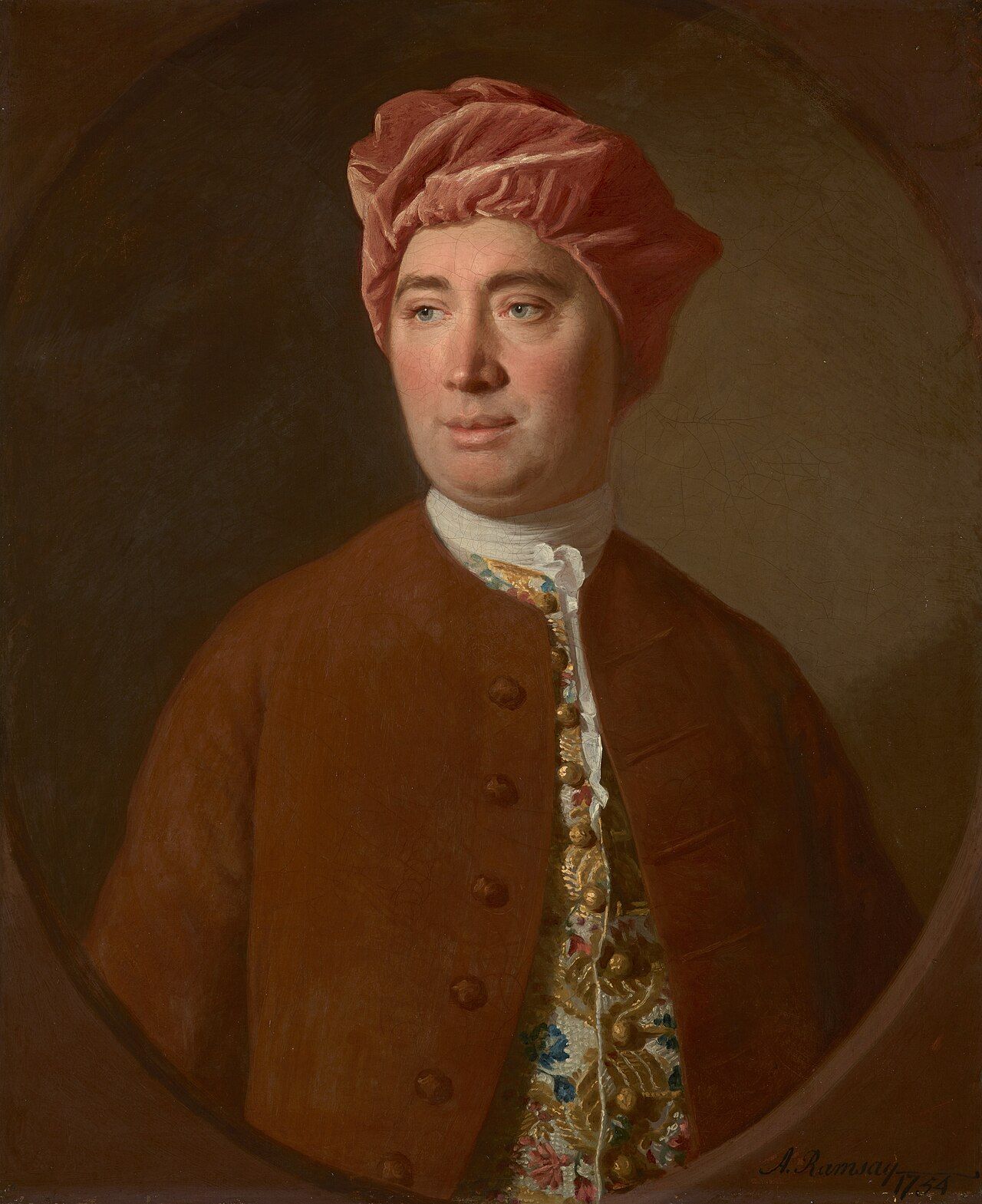
The view
Hume discussed liberty and necessity twice: in A Treatise of Human Nature (1739–40), and more famously in Section VIII of An Enquiry Concerning Human Understanding (1748). He called his approach a "reconciling project". The quarrel between the defenders of liberty and the defenders of necessity, he said, had gone on for two thousand years only because nobody had defined the terms.
By necessity, Hume meant no more than what his analysis of causation allowed: regular conjunction, and the inference we make from one event to another. In that sense human actions are as necessary as the motions of the planets. Merchants count on their workers, generals on their soldiers, and a prisoner on the obstinacy of his gaoler no less than on the thickness of the walls. History, politics and everyday life all depend on the uniformity of human behaviour.
The argument
By liberty, then, we can only mean a power of acting or not acting, according to the determinations of the will; that is, if we choose to remain at rest, we may; if we choose to move, we also may. Now this hypothetical liberty is universally allowed to belong to every one who is not a prisoner and in chains. Hume, An Enquiry Concerning Human Understanding VIII (1748)
Hume's "hypothetical liberty" is a conditional: if you choose to move, you can. It does not ask where the choice came from. A person is free when their actions follow their will, and unfree when something, like chains, would block the action whatever they willed. Test the conditional below.
Then Hume turns the tables. Liberty in the libertarian's sense, an act with no cause at all, would be the same as chance. And chance would destroy responsibility. We blame people for their actions only because the actions come from something durable in them: their character and dispositions. An act that sprang from nothing would reflect nothing about the person, and they could no more be blamed for it than for a twitch. So responsibility requires necessity, rightly understood.
Where he meets Dennett
Hume is Dennett's most important predecessor, and the parallels are close. Both treat the problem as partly a confusion of words. Both say that the predictability of human behaviour is a condition of social life, not a threat to it. And Hume's argument that chance would undermine responsibility is the ancestor of Dennett's verdict on the swerve and on the libertarian's random generator: randomness takes control away from the agent rather than giving it.
Where they part
Hume's liberty is close to Hobbes's: the action follows the will, and nothing blocks it. Dennett thought that left too much out. A creature that does what it wants is not yet a responsible agent; it also needs to be able to reflect on what it wants, respond to reasons and learn. Hume also had no account of where wills come from, beyond custom and passion. Dennett supplies one, from evolution, upbringing and culture, and with it an explanation of why freedom differs from person to person and can be increased.
| Hume | Dennett | |
|---|---|---|
| Is everything fixed by prior causes? | Human actions are as regular as natural events, in the only sense of necessity we understand. | Perhaps. Freedom does not depend on the answer. |
| Is free will compatible with determinism? | Yes. The dispute was verbal all along. | Yes. Every kind of freedom worth wanting survives determinism. |
| Do we have free will? | We have hypothetical liberty, unless in chains. | Yes: an evolved capacity to act for reasons, which comes in degrees. |
| Does anyone deserve blame? | Yes, because actions flow from durable character. | Yes, within a fair system of rules that free agents have reason to accept. |
Further reading
- David Hume, An Enquiry Concerning Human Understanding, Section VIII, "Of Liberty and Necessity".
- Paul Russell, Freedom and Moral Sentiment: Hume's Way of Naturalizing Responsibility (Oxford, 1995).
- For Hume on the self, see the Hume page on our sister site, Philosophy of Mind.