Malmesbury, 1588–1679
Thomas Hobbes
A free man is one who is not hindered from doing what he has a will to do. Whether the will itself has causes is beside the point: of course it does. Liberty and necessity are perfectly consistent.
The view
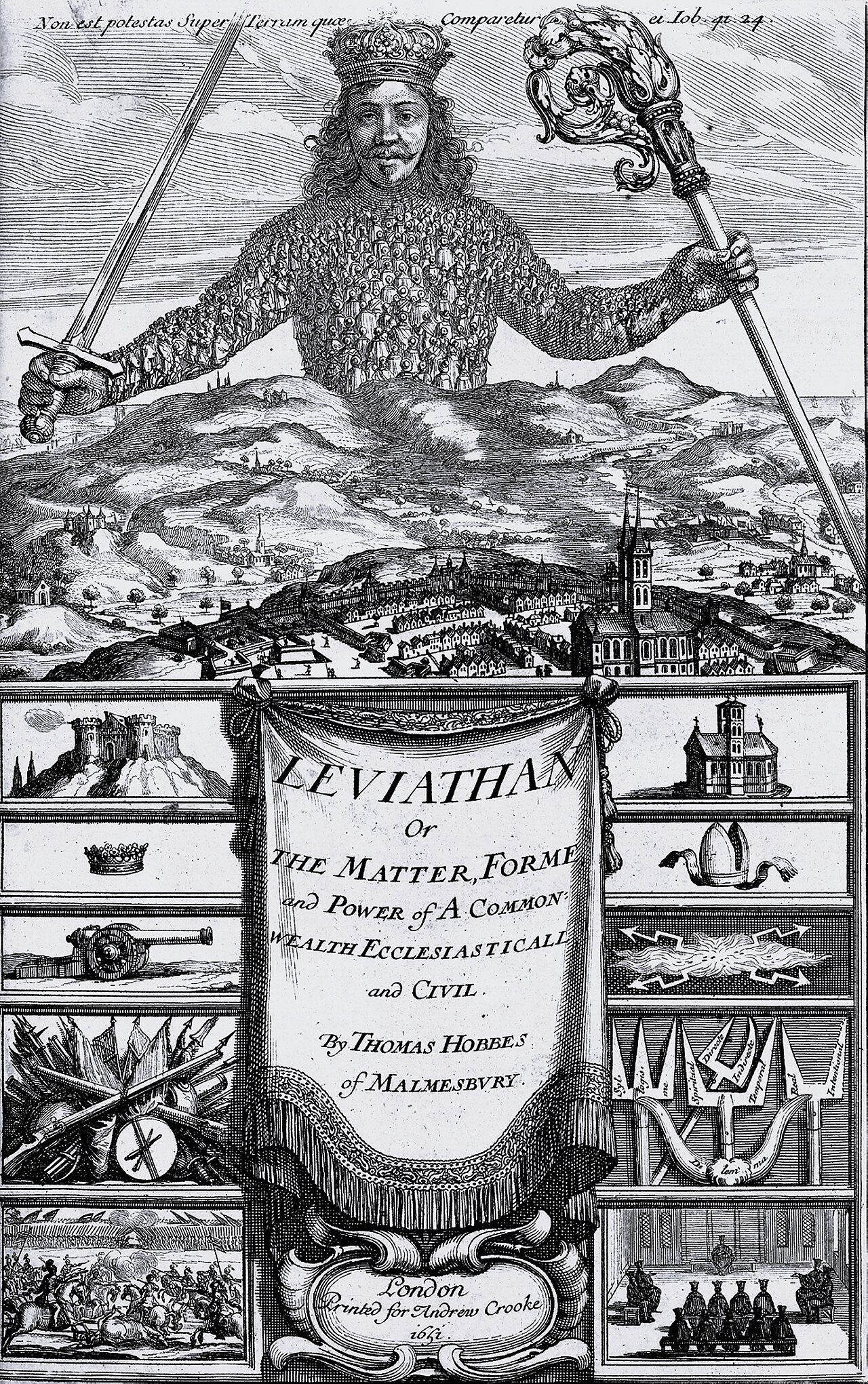
Hobbes was a thoroughgoing materialist. Everything that exists is body, and everything that happens is motion caused by prior motion. He applied this picture to politics in Leviathan (1651), and to the will in a fierce public exchange with John Bramhall, Bishop of Derry. Their debate, begun in Paris in 1645, was published without Hobbes's consent in 1654 as Of Liberty and Necessity, and the two men carried on in print for years.
Bramhall defended a libertarian freedom: the will must be able to choose either way, with all the conditions for choosing in place. Hobbes thought this was nonsense. Nothing, the will included, begins to move of itself. Every act of will has a sufficient cause, and so is necessary. But this takes nothing away from liberty, because liberty was never about the will in the first place. It is about the absence of obstacles.
The argument
Liberty and necessity are consistent: as in the water, that hath not only liberty, but a necessity of descending by the channel. Hobbes, Leviathan, chapter 21 (1651)
Liberty, Hobbes says, is "the absence of external impediments", and it applies to bodies of every kind. Water in an open channel flows freely; dam it, and it is not free. The water's flow is also completely necessary, driven by gravity. In the same way, a man who acts on his will, unhindered, acts freely, even though his will was caused by prior motions in his body and the world. Open and close the channel below.
Hobbes added that fear and liberty are consistent too. A man who throws his goods into the sea for fear the ship will sink does it willingly, and could refuse if he would. It was Aristotle's example of a mixed act, put to new use: an act done under pressure is still free if nothing outside stopped the agent from doing otherwise.
Where he meets Dennett
Hobbes is the founder of modern compatibilism, and Dennett is his heir. Both refuse to give the will any exemption from causation, and both say that freedom is a matter of what an agent is able to do, not whether its acts have causes. Hobbes's impatience with the libertarian's self-moving will, which he thought was a confusion of words, anticipates Dennett's verdict that the libertarian's extra ingredient does no work.
Where they part
Hobbes's account is too thin for Dennett. On Hobbes's definition the water is as free as a person, and a falling stone is free until it hits the ground. That shows his "liberty" leaves out what makes human freedom special: deliberation, foresight, responsiveness to reasons and the ability to reflect on one's own desires. Dennett's freedom is a property of sophisticated control systems, not of anything that moves unobstructed. Hobbes asked whether anything stands in the agent's way; Dennett also asked what kind of agent it is.
| Hobbes | Dennett | |
|---|---|---|
| Is everything fixed by prior causes? | Yes. Every motion has a sufficient cause. | Perhaps. Freedom does not depend on the answer. |
| Is free will compatible with determinism? | Yes. Liberty is the absence of external impediments. | Yes. Every kind of freedom worth wanting survives determinism. |
| Do we have free will? | We have liberty of action; a "free will" in Bramhall's sense is absurd. | Yes: an evolved capacity to act for reasons, which comes in degrees. |
| Does anyone deserve blame? | Punishment is justified by its use in shaping the will. | Yes, within a fair system of rules that free agents have reason to accept. |
Further reading
- Thomas Hobbes, Leviathan, chapter 21, "Of the Liberty of Subjects".
- Vere Chappell (ed.), Hobbes and Bramhall on Liberty and Necessity (Cambridge, 1999).
- Hobbes's moral and political philosophy, Stanford Encyclopedia of Philosophy.