Thagaste and Hippo, AD 354–430
Augustine
If God made everything and knows everything in advance, where does evil come from, and how can anyone be blamed for it? Augustine's answer put the free choice of the will at the centre of Western thought for a thousand years.
The view
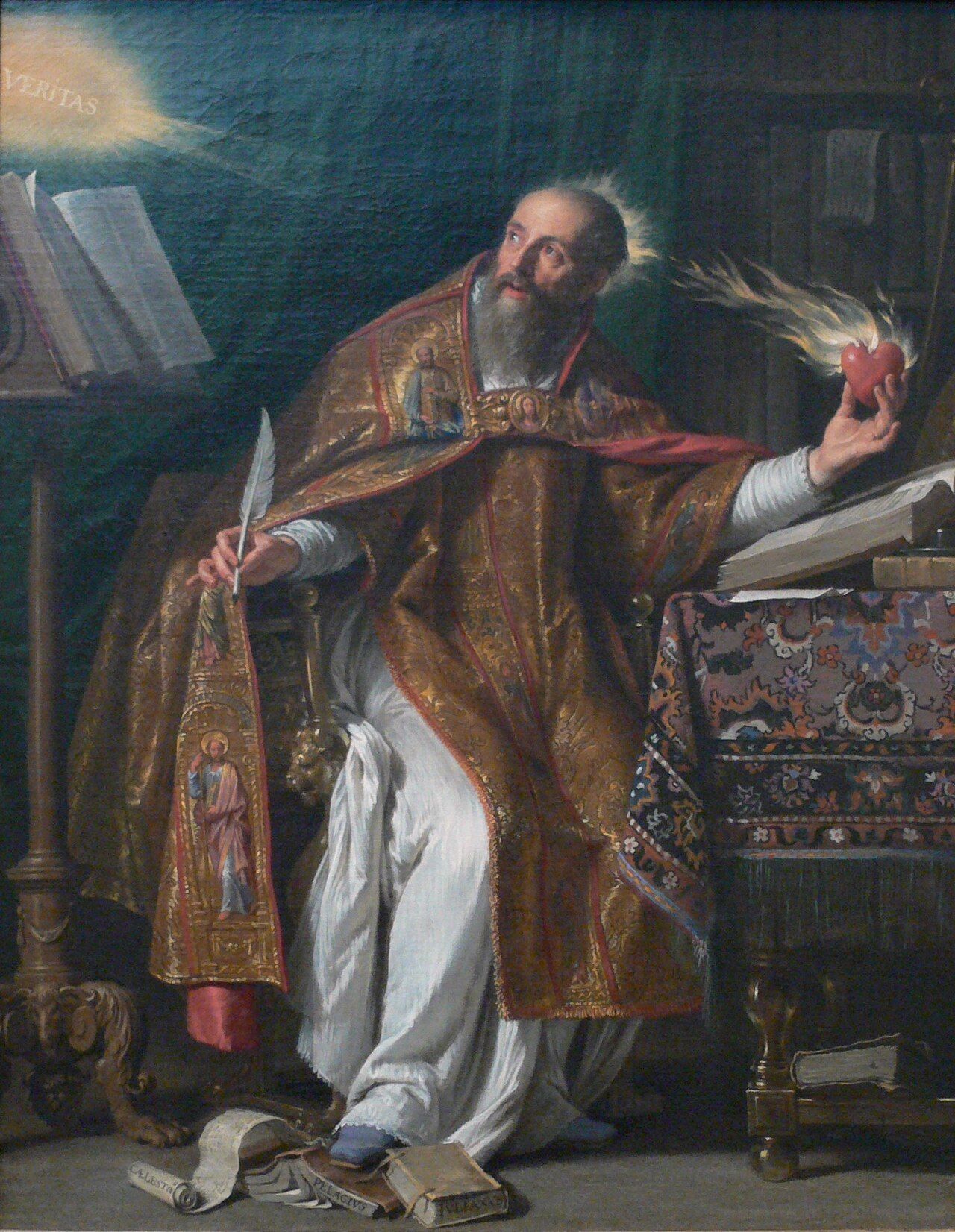
Augustine was born in North Africa, taught rhetoric in Carthage, Rome and Milan, and was converted to Christianity in 386, a story he tells in his Confessions. As bishop of Hippo, he became the most influential theologian of the Latin West. Soon after his conversion he began a dialogue, On Free Choice of the Will (De libero arbitrio), finished around 395.
The dialogue starts from the problem of evil. God is good and made everything; so where does evil come from? Augustine's answer is that moral evil comes from the free choice of rational creatures, who turn away from the higher good towards lower ones. God gave us free will because without it we could not live rightly, and could not deserve praise. That the gift can be misused is the price of its value.
The argument
Your memory does not force past events to have happened. In the same way, God's foreknowledge does not force future events to happen. Augustine, On Free Choice of the Will III.4 (our paraphrase)
His friend Evodius then raises the problem that has never gone away. If God knows in advance that I will sin, I must sin; how then is the sin free? Augustine replies that knowing something will happen does not make it happen. God foreknows that I will sin freely, and so what he foreknows is a free act. A century later, the Roman philosopher Boethius, writing in prison, offered a further answer. God does not foresee at all. He is outside time, and sees every moment at once, as we see what is present before us. Compare the two pictures below.
Augustine's later writings complicate the picture. In his long controversy with Pelagius, who held that people can choose to live without sin by their own efforts, Augustine insisted that after the Fall the will is so damaged that it cannot choose the good without God's grace. Readers have argued ever since about whether the late Augustine left any room for the free will the early Augustine defended.
Where he meets Dennett
In one surprising respect. Augustine saw that knowledge of what someone will do does not, by itself, take away their freedom. Dennett agreed and went further: we often want to be predictable. A friend who knows we will keep a promise, or a colleague who can count on our honesty, takes nothing from our freedom; their confidence depends on it. The Augustinian insight that prediction is not compulsion is one of Dennett's main weapons against the bogeymen of determinism.
Where they part
Everywhere else. Augustine's free will is a power of a created soul, given by God and answerable to him, and its proper use is to love God. The problems that drove him, evil, grace and divine knowledge, have no place in Dennett's naturalism, where the only observer who might know the future is a thought-experiment, not a judge. And where the late Augustine thought the will cannot rescue itself without grace, Dennett thought freedom is something creatures build for themselves, together, over evolutionary and cultural time.
| Augustine | Dennett | |
|---|---|---|
| Is everything fixed by prior causes? | Everything is known to God, but the will's choices are its own. | Perhaps. Freedom does not depend on the answer. |
| Is free will compatible with determinism? | It is compatible with foreknowledge; the question of physical causes is not his. | Yes. Every kind of freedom worth wanting survives determinism. |
| Do we have free will? | Yes, God's gift, though after the Fall it cannot choose the good without grace. | Yes: an evolved capacity to act for reasons, which comes in degrees. |
| Does anyone deserve blame? | Yes. Sin is the will's own turning away. | Yes, within a fair system of rules that free agents have reason to accept. |
Further reading
- Augustine, On the Free Choice of the Will, translated by Thomas Williams (Hackett, 1993).
- Boethius, The Consolation of Philosophy, Book V; translated by Victor Watts (Penguin, 1999).
- Augustine's account of time appears on our sister site, Philosophy of Time.
- Saint Augustine, Stanford Encyclopedia of Philosophy.