Danzig and Frankfurt, 1788–1860
Arthur Schopenhauer
You can do whatever you will. But you cannot will whatever you will. Every act follows necessarily from your character and your motives, and if there is freedom anywhere, it lies not in what you do, but in what you are.
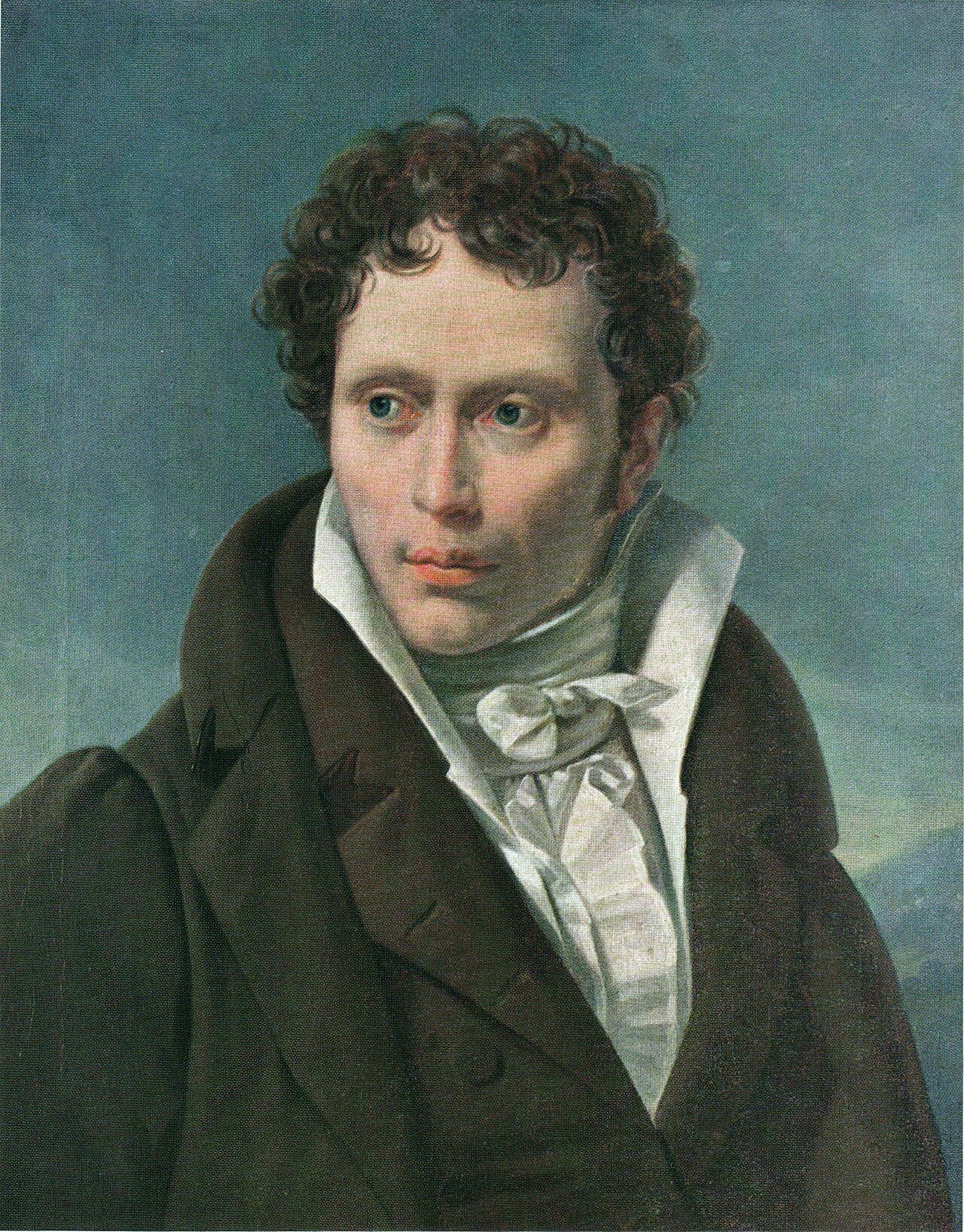
The view
In 1839 the Royal Norwegian Society of Sciences awarded Schopenhauer its prize for an essay answering the question: can the freedom of the human will be proved from self-consciousness? His answer was no. Self-consciousness tells you only that you can do what you will. It says nothing at all about whether your will itself could have been different.
Schopenhauer then argued, from outside, that it could not. Every action follows from two things: a motive, which is a cause like any other, working through the intellect; and the person's character, which is inborn and unchangeable. Given both, the action follows as surely as a stone falls. We learn our own characters, as we learn other people's, only by watching what we do.
The argument
A man can do what he wills, but he cannot will what he wills. The usual summary of Schopenhauer's Prize Essay on the Freedom of the Will (1839), our translation
His own example is a man standing in the street at six in the evening. He says to himself: I can go for a walk; I can go to the club; I can climb a tower to watch the sun set; I can go to the theatre; I can visit a friend; I can even run out of the city gate into the wide world and never come back. All of it is up to me. But I will do none of it. I will go home to my wife. Open his options, then reveal his motives.
Schopenhauer says the man's sense of freedom is like water saying: I can make high waves, I can rush downhill, I can foam over a waterfall, I can rise into the air as a fountain, and today I choose to stay calm in the pond. Water can do all these things, but only when the right causes act on it. So can the man.
Yet we do feel responsible, and Schopenhauer thought the feeling is not wrong; it is misplaced. We hold ourselves accountable not for what we did, which was necessary, but for who we are. Following Kant, he placed freedom in the timeless "intelligible character" behind the empirical one. In his Latin slogan, freedom belongs not to operari, doing, but to esse, being.
Where he meets Dennett
Schopenhauer's analysis of action is hard-headed in a way Dennett admired: actions follow from character and reasons, and the introspective feeling that you could have done anything at all proves nothing. Dennett would agree that self-consciousness cannot reveal whether the will is free in the libertarian's sense, because no inner observation could reveal that about anything. And both think that, in the end, responsibility attaches to what kind of agent you are.
Where they part
Schopenhauer held that character is inborn and fixed. Dennett thought the opposite: character is built, over a lifetime, by upbringing, experience, choices and the reasons we accept, and it can be changed. That is why, for Dennett, "you cannot will what you will" is half true at best. Today you cannot simply decide to want differently, but you can set out to become someone who will, by practice, by binding yourself, by changing your surroundings. And Dennett had no need for a timeless intelligible character; the freedom of being, for him, is the gradual self-making of a natural creature.
| Schopenhauer | Dennett | |
|---|---|---|
| Is everything fixed by prior causes? | Yes. Every act follows from character and motive. | Perhaps. Freedom does not depend on the answer. |
| Is free will compatible with determinism? | Freedom of action, yes; freedom of the will, no. | Yes. Every kind of freedom worth wanting survives determinism. |
| Do we have free will? | Not in what we do; perhaps, transcendentally, in what we are. | Yes: an evolved capacity to act for reasons, which comes in degrees. |
| Does anyone deserve blame? | We are rightly held to account for our character, our very being. | Yes, within a fair system of rules that free agents have reason to accept. |
Further reading
- Arthur Schopenhauer, Prize Essay on the Freedom of the Will, edited by Günter Zöller (Cambridge, 1999).
- Christopher Janaway, Schopenhauer: A Very Short Introduction (Oxford, 2002).
- Arthur Schopenhauer, Stanford Encyclopedia of Philosophy.