Normandy and Paris, 1749–1827
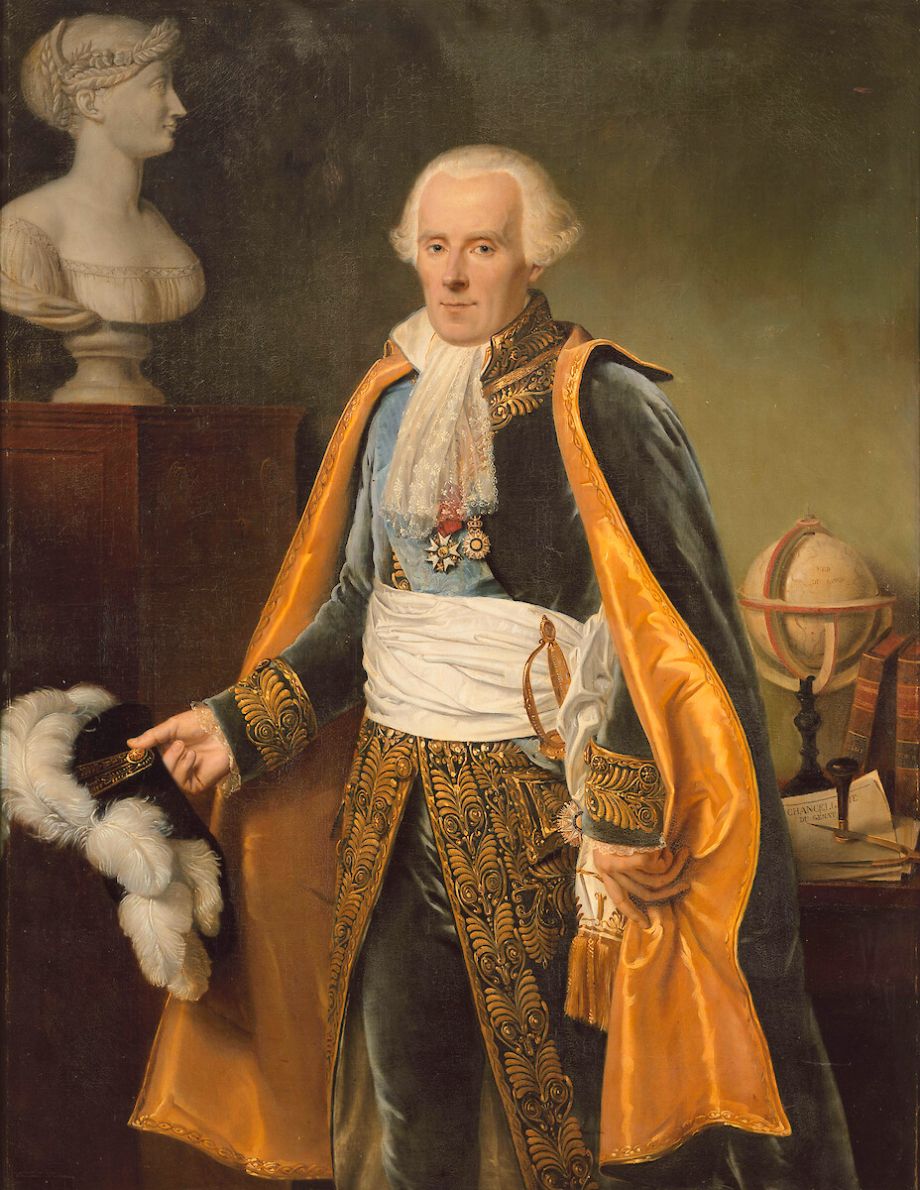
Pierre-Simon Laplace
An intellect that knew every force in nature and the position of every particle, and could analyse it all, would find nothing uncertain. The future, like the past, would lie open before its eyes. It became determinism's most famous image, and its most frightening.
The view
Laplace was the leading mathematical physicist of his age. His five-volume Celestial Mechanics (1799–1825) showed that the solar system's apparent irregularities follow from Newton's laws, with no need for God to step in and correct them. He also founded much of the modern theory of probability. It was in the introduction to his work on probability, the Philosophical Essay on Probabilities (1814), that he set out the image later critics named Laplace's demon.
Laplace himself said little about free will. His point was about probability: we need it only because of our ignorance. To an intellect with complete knowledge of the present state of the universe and the laws of nature, nothing would be probable or improbable; everything would be certain. But readers immediately saw the implication. If the demon could predict everything, it could predict every choice you will ever make, before you were born.
The argument
For such an intellect nothing would be uncertain, and the future, like the past, would be present before its eyes. Laplace, Philosophical Essay on Probabilities (1814), our translation
The demon's predictions depend on knowing the present exactly. In many real systems, the smallest error in the starting point grows until the prediction is worthless; this is what is now called chaos, first glimpsed by Henri Poincaré in the 1880s. Run two worlds below that start from almost identical states.
Chaos does not refute determinism. Both balls obey exact laws, and a demon with infinite precision would still predict them. It shows that prediction and determinism come apart: a world can be fully determined and yet unpredictable by anything that lives inside it. Quantum mechanics, in the twentieth century, raised a deeper question, whether the laws themselves are deterministic at all. Physicists still disagree, depending on how they interpret the theory.
Where he meets Dennett
Dennett accepted Laplace's physics as a perfectly possible picture of the world. He never pinned freedom on its being false, and he warned against hoping that quantum indeterminacy or chaos would rescue free will. Neither randomness nor unpredictability, by itself, makes an agent more responsible.
Where they part
On the demon's significance. For Dennett the demon is one of the bugbears: an imaginary agent who knows our every move in advance and so seems to make us puppets. But the demon does not control anything. It only knows. And the most it could know about us is what the laws and the facts already contain, including our deliberations, which are among the causes of what we do. Dennett also stressed the practical point Laplace's image hides: real agents, ourselves included, can never step outside the world to predict it whole, so from our point of view, the future is always open for deliberation. That is the only openness deliberation ever needed.
| Laplace | Dennett | |
|---|---|---|
| Is everything fixed by prior causes? | Yes. Uncertainty is only ignorance. | Perhaps. Freedom does not depend on the answer. |
| Is free will compatible with determinism? | Not his question; his readers concluded it was not. | Yes. Every kind of freedom worth wanting survives determinism. |
| Do we have free will? | He did not say. | Yes: an evolved capacity to act for reasons, which comes in degrees. |
| Does anyone deserve blame? | He did not say. | Yes, within a fair system of rules that free agents have reason to accept. |
Further reading
- Pierre-Simon Laplace, A Philosophical Essay on Probabilities (1814), introduction.
- John Earman, A Primer on Determinism (Reidel, 1986).
- For time, determinism and the open future, see our sister site, Philosophy of Time.
- Causal determinism, Stanford Encyclopedia of Philosophy.