New York and Cambridge, Massachusetts, 1842–1910
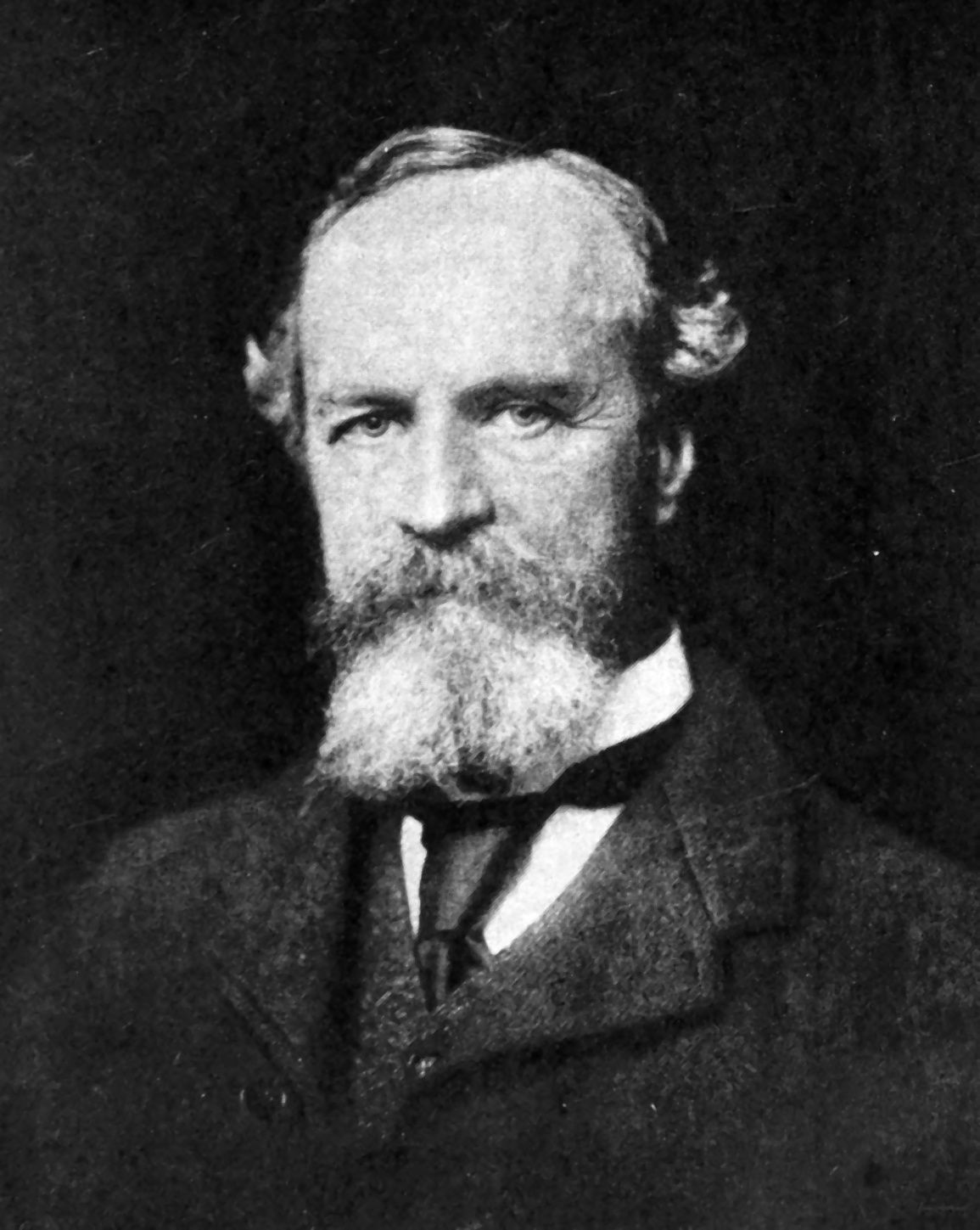
William James
If determinism is true, then every regret is a mistake, because nothing could ever have gone better. James could not accept a world like that. He chose to believe in an open future, with real possibilities and real chance, and he chose it freely.
The view
James trained as a doctor, taught physiology and then psychology at Harvard, and wrote The Principles of Psychology (1890), the founding textbook of the subject. In April 1870, in the depths of a crisis, he wrote in his diary: "My first act of free will shall be to believe in free will." He thought the question could not be settled by evidence, so it was one on which a person had the right to choose what to believe.
He set out his case in a lecture to Harvard divinity students in 1884, "The Dilemma of Determinism". He coined the terms "hard determinism", for the view that accepts determinism and denies freedom, and "soft determinism", for the compatibilists who accept determinism and keep the word freedom. Soft determinism, he said, was "a quagmire of evasion".
The argument
What divides us into possibility men and anti-possibility men is different faiths or postulates, postulates of rationality. James, "The Dilemma of Determinism" (1884)
James asked his audience to imagine him leaving the lecture hall. He can walk home by Divinity Avenue or by Oxford Street. Suppose he takes Divinity Avenue. Now rewind the universe and suppose he takes Oxford Street instead. Could anyone, looking at either world, say that it was irrational, or that it showed a defect? No. Both worlds look equally natural from inside. So the idea of chance in human choices does not make the world look capricious. Try it below.
Then came the argument from regret. Not long before, a man in Brockton had murdered his wife, and the newspapers were full of it. We all judge that this was bad, that it ought not to have happened. But on determinism it could not have failed to happen; it was part of the one possible world. Regretting it would be regretting the whole universe. The determinist is forced either into pessimism, wishing the whole thing different, or into a cold indifference that calls even the murder good in its place. Only if there were real alternatives does regret make sense.
Where he meets Dennett
More than his rhetoric suggests. James's argument that chance would not make the world look irrational anticipates Dennett's pseudo-random generator: from the inside, nobody could tell the difference. And his psychology of the will, with its account of ideas competing for attention until one wins and is acted on, is close in spirit to Dennett's model of the mind as many processes competing for influence. Dennett named the two-stage model after Valéry, but James had sketched it.
Where they part
Dennett was exactly what James called a soft determinist, and he thought the "quagmire of evasion" was firm ground. On regret, Dennett's reply would be that regret is forward-looking. We regret the murder because such acts can be prevented by better design: better laws, upbringing and help for the people at risk. The world needs no open branches for that, only creatures who learn. And Dennett had no time for settling a question by an act of faith. Whatever the comfort of James's belief, the question was empirical and conceptual, and should be settled by argument.
| James | Dennett | |
|---|---|---|
| Is everything fixed by prior causes? | He chose to believe not: the universe has real possibilities. | Perhaps. Freedom does not depend on the answer. |
| Is free will compatible with determinism? | No. Soft determinism is a quagmire of evasion. | Yes. Every kind of freedom worth wanting survives determinism. |
| Do we have free will? | Yes, as a postulate we have the right to choose. | Yes: an evolved capacity to act for reasons, which comes in degrees. |
| Does anyone deserve blame? | Yes, and regret and judgement make sense only if we are free. | Yes, within a fair system of rules that free agents have reason to accept. |
Further reading
- William James, "The Dilemma of Determinism", in The Will to Believe and Other Essays in Popular Philosophy (1897).
- William James, The Principles of Psychology (1890), chapter 26, "Will".
- Robert D. Richardson, William James: In the Maelstrom of American Modernism (Houghton Mifflin, 2006).