Athens, 341–270 BC, and Rome, c. 99–55 BC
Epicurus and Lucretius
If atoms only ever fell in straight lines, every motion would follow from the last, and the bonds of fate could never be broken. So, at no fixed time or place, the atoms must swerve, ever so slightly. That swerve is where free will comes from.
The view
Epicurus founded his school, the Garden, in Athens around 306 BC. He took over the atomism of Democritus: everything is made of indivisible atoms moving through the void. Democritus seemed to make everything necessary, and Epicurus saw the danger. If the motion of atoms fixes all our thoughts and acts, he complained, we are slaves of fate, and that is worse than believing the myths about the gods, who can at least be won over by prayer.
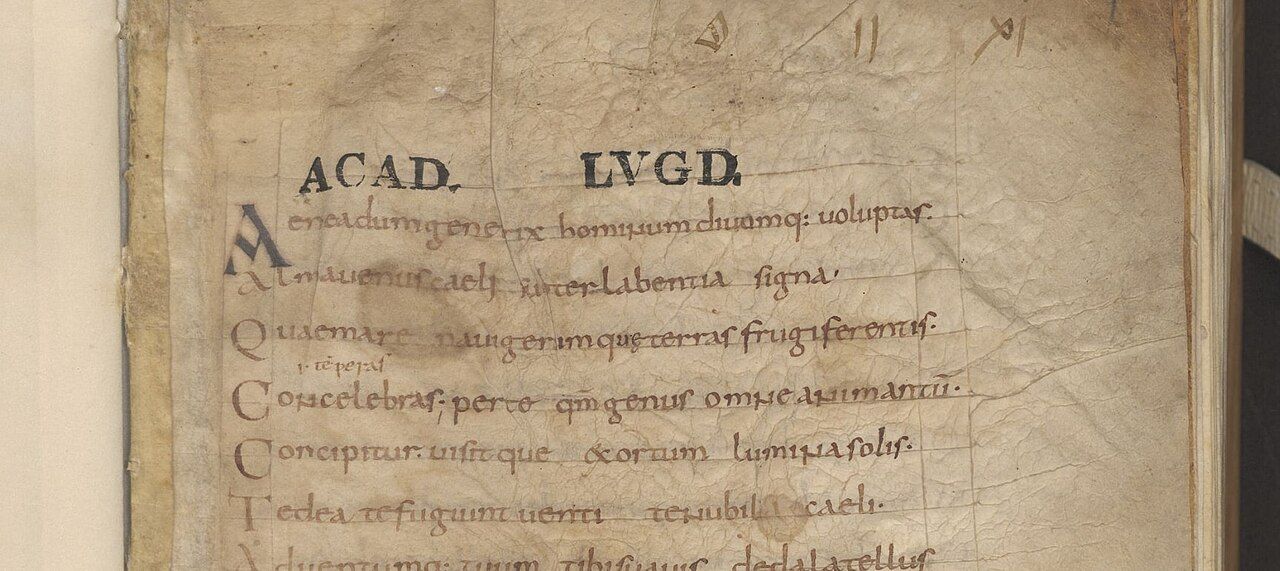
His solution was the swerve, or in Latin clinamen: a minimal, uncaused sideways deviation of an atom from its path. Very little of Epicurus's own writing survives, and our fullest account of the swerve comes from the Roman poet Lucretius, whose De rerum natura (On the Nature of Things) set out Epicurean physics in six books of Latin verse, around 50 BC.
The argument
If every motion is linked to another, and new follows old in a fixed order, and the atoms never swerve to start some new motion that breaks the laws of fate, so that cause does not follow cause for ever, where does this free will in living things come from? Lucretius, De rerum natura II.251–257 (our translation)
Lucretius points to racehorses at the start. When the gates are flung open, the horses cannot surge forward as fast as their minds desire; the impulse has to spread from the mind through the body first. The start of a voluntary motion, he says, comes from the will. And for there to be a will that is not just one more link in the chain, there must be some break in the chain. Watch what a tiny swerve does below.
The swerve did a second job in Epicurean physics. Without it, atoms falling in parallel would never collide, and no world could ever form. One small break in determinism was meant to explain both the existence of things and the freedom of minds.
Where they meet Dennett
Only in the starting point. Epicurus and Dennett share a thoroughly materialist picture: no souls outside nature, nothing but matter in motion. And both wanted to show that such a world has room for responsibility. Epicurus was also a moralist with a practical aim, freeing people from fear, which Dennett would have recognised: Elbow Room is in large part a book about dispelling needless fears.
Where they part
On the swerve itself, sharply. Critics in antiquity already mocked it as an uncaused event invented to save a theory. Dennett's objection is different and deeper: even if there were such swerves, they would not help. A random jolt in the brain would not make an act more yours; it would make it less predictable, and less under the control of your reasons. That is the point of his pseudo-random generator in the Valerian model. Modern physics has given the libertarian real indeterminism to work with, in quantum mechanics, but Dennett argued that the problem with the swerve was never a shortage of physics.
| Epicurus and Lucretius | Dennett | |
|---|---|---|
| Is everything fixed by prior causes? | No. Atoms swerve without cause. | Perhaps. Freedom does not depend on the answer. |
| Is free will compatible with determinism? | No. Fate would make us slaves. | Yes. Every kind of freedom worth wanting survives determinism. |
| Do we have free will? | Yes, thanks to the swerve. | Yes: an evolved capacity to act for reasons, which comes in degrees. |
| Does anyone deserve blame? | Yes; Epicurus insisted that our acts are our own. | Yes, within a fair system of rules that free agents have reason to accept. |
Further reading
- Lucretius, On the Nature of Things, Book II; translated by A. E. Stallings (Penguin, 2007), in verse.
- Stephen Greenblatt, The Swerve: How the Renaissance Began (Bodley Head, 2011): the rediscovery of Lucretius in 1417.
- Epicurus, Stanford Encyclopedia of Philosophy.